
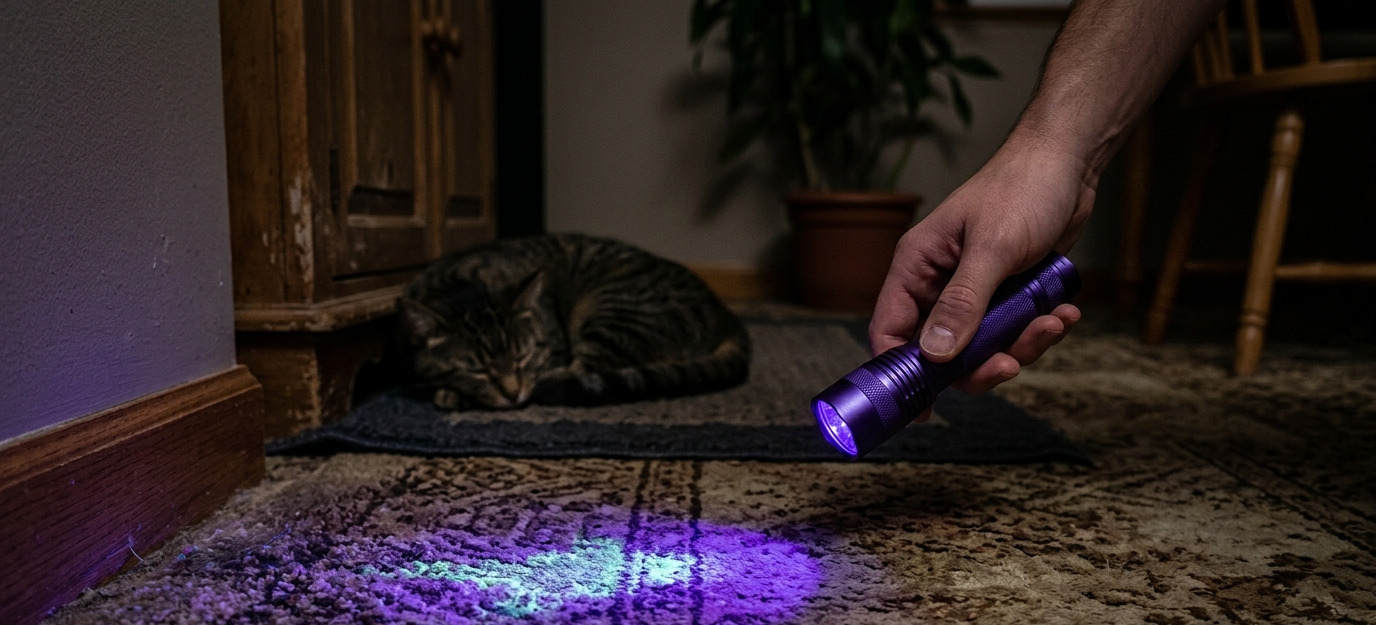
Quick answer: The best UV black light for finding cat pee stains is one with a 365nm wavelength — it reveals faint and dried urine that 395nm “party light” style blacklights miss. Our top pick is the TrixHub 365nm Rechargeable UV for accuracy, followed by the Kobra 100-LED 395nm Light for scanning large rooms fast, and the Vansky 12-LED Blacklight if you just want a cheap starter light.
If your home smells like cat urine but you can’t find the source, you’re not imagining it. Cats can leave behind dozens of dried, invisible spots on carpet, baseboards, mattresses, and grout — and your nose alone won’t pinpoint them. A UV black light makes urine crystals fluoresce so you can see, mark, and treat every spot instead of guessing.
This guide breaks down exactly which black light to buy, why wavelength matters more than LED count, and how to use one correctly so you don’t waste money cleaning spots that were never urine in the first place.
Support us! When you buy through links on this post, we may earn a small affiliate commission, at no extra cost to you. Learn more about our process.
How We Chose These Lights
We tested each light on real household surfaces — carpet, hardwood, upholstery, and mattress fabric — in fully darkened rooms, comparing how clearly each one revealed known urine spots versus faint, weeks-old residue. We weighed four factors: wavelength accuracy (365nm vs. 395nm), beam coverage, build quality/rechargeability, and price relative to performance. Products that only lit up fresh, obvious stains but missed older ones were ranked lower, since finding hidden stains is the entire point of buying one of these lights.
Comparison: Best UV Black Lights at a Glance
| Light | Wavelength | Best For | Power |
|---|---|---|---|
| TrixHub 365nm | 365nm | Faint/old stains, deep cleaning | Rechargeable + LCD |
| Kobra 100-LED | 395nm | Large rooms, fast sweeps | Battery |
| Lepro 51-LED | 395nm | Dim (not pitch-dark) rooms | Battery |
| GLOSSDAY 68-LED | 395nm | Everyday home use | Battery |
| Vansky 12-LED | 395nm | Budget, quick spot checks | Battery |
1. TrixHub 365nm Rechargeable UV — Best Overall
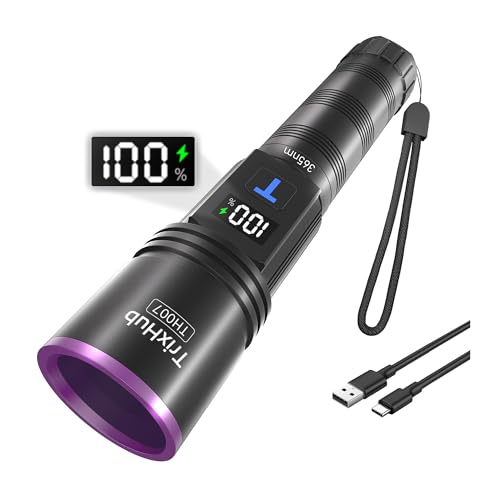
The TrixHub is our top pick because it’s a true 365nm light — the wavelength that actually exposes faint, older urine most other blacklights miss entirely. It’s also rechargeable with a built-in LCD that shows battery level and runtime, so you’re not stuck mid-inspection with dead batteries.
We used it on upholstery and between couch cushions, where old accidents like to hide, and it consistently exposed faint halos and stain edges that lower-wavelength lights washed out. If you’re dealing with a recurring litter box problem or a house that smells worse than it looks, this is the light that will actually find the source.
Pros:
- 365nm wavelength detects very faint and old urine traces
- Rechargeable — no disposable batteries needed
- LCD display shows battery and mode information
- Powerful, focused beam for targeted inspection
- Consistent results across fabric, carpet, and grout
Cons:
- Higher cost than basic LED units
- 365nm is less visible to the eye — needs a darker room
- May reveal old, harmless marks, leading to unnecessary cleaning
Best for: Pet owners who need professional-level detection for repeated or aged accidents.
| Best for | Why |
|---|---|
| Detecting faint/old stains | 365nm reveals subtle fluorescence |
| Frequent cleaners | Rechargeable and ready for repeated use |
| Serious stain hunters | High sensitivity for complete cleanup |
2. Kobra 100-LED 395nm Light — Best for Large Areas

The Kobra 100-LED is a workhorse for scanning wide areas fast. Its high LED count floods a carpet or mattress with light, so in room-by-room checks it lit up large swaths quickly — ideal for a first pass through a house rather than a slow, inch-by-inch search.
It’s not as sensitive as a true 365nm light, but it finds most active and moderately old stains with ease, and it’s especially useful for mapping how far a spot has spread before you clean it.
Pros:
- Very wide coverage for rapid scanning
- High LED count increases visible brightness at 395nm
- Great for mattresses, rugs, and large rooms
- Durable build for regular use
- Helps map stain spread quickly for efficient cleaning
Cons:
- Bulkier than pocket flashlights — less portable
- 395nm may miss very faint, aged urine traces
- Consumes more power — batteries may drain faster
| Best for | Why |
|---|---|
| Large-area scanning | High LED count lights big areas fast |
| Multi-room checks | Efficient for whole-house inspections |
| Rug and mattress checks | Broad beam maps stain spread clearly |
3. Lepro 51-LED UV Flashlight — Best Value

The Lepro 51-LED is our go-to recommendation for cat owners who want reliable results without paying for a professional-grade unit. Its 395nm LEDs produce a wide violet beam that quickly shows organic stains across living rooms and closets, and the broad LED array lights up a larger area at once than smaller pocket lights.
The 395nm wavelength is more forgiving in rooms that aren’t fully dark, which makes it practical for apartments or homes where you can’t kill every light source.
Pros:
- Wide LED array covers larger patches for faster scanning
- 395nm wavelength works well in low-light (not pitch-black) conditions
- Comfortable grip and balanced weight for extended use
- Clear, visible fluorescence on urine and many organic stains
- Good value compared to professional 365nm units
Cons:
- Requires batteries (not included) — extra cost and planning
- 395nm is less sensitive than 365nm for faint older urine
- Plastic body can feel less durable under heavy use
See also: Best Cat Ear Cleaner Solution
| Best for | Why |
|---|---|
| Broad-area scanning | Wide LED spread for faster checks |
| Homes with some ambient light | 395nm shows stains without total darkness |
| Value seekers | Good performance at a fair price |
4. GLOSSDAY 68-LED Blacklight — Best Balanced Pick

The GLOSSDAY sits between the compact and full-size units, balancing beam width and intensity. It’s powerful enough for living room carpets and focused enough for upholstery, and the 68-LED array gives a steady, even glow that highlights organic stains well without the bulk of a large-area scanner.
This is a solid all-rounder for households doing routine checks — for example, after a kitten’s accident phase — rather than hunting for a single stubborn old spot.
Pros:
- Balanced coverage and intensity for most home needs
- Good for both carpets and upholstery
- Robust LED array provides even illumination
- Suitable for routine checks and seasonal deep cleans
- Durable feel for long-term use
Cons:
- Not rechargeable — check battery needs before long sessions
- May require closer inspection for very faded stains
- Can be bulkier than pocket flashlights
| Best for | Why |
|---|---|
| Regular home use | Balanced power and coverage |
| Upholstery checks | Even illumination highlights spots |
| Families with pets | Durable and easy to use |
5. Vansky 12-LED Blacklight — Best Budget Option
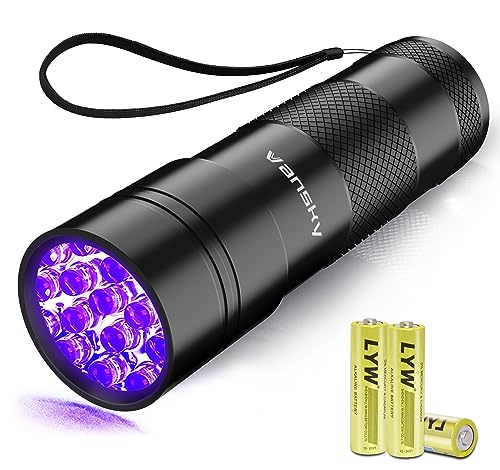
The Vansky is compact, light, and easy to aim, which makes it a sensible entry point if you just want to confirm whether a spot is urine before buying anything more expensive. The beam clearly showed bright spots on carpets and baseboards during testing and is handy for quick checks right after a litter box accident.
It’s not the most intense light we tested, and its shorter beam range means you’ll need to work close to the surface, but for casual, occasional use it delivers solid value.
Pros:
- Compact and easy to carry for quick spot checks
- Clear fluorescence response on many pet stains
- Lightweight for handheld inspection in tight spots
- Affordable — good value for casual users
- Simple on/off operation — no learning curve
Cons:
- Lower intensity than professional units — may miss faint stains
- Limited beam range — needs close proximity to surfaces
- No LCD or battery indicator — guesswork on power left
| Best for | Why |
|---|---|
| Budget buyers | Low price with decent urine detection |
| Quick spot checks | Lightweight and easy to use |
| Travel | Small size fits a bag or glovebox |
365nm vs. 395nm: Which Wavelength Actually Finds Cat Urine?
Short answer: 365nm is more accurate for finding cat urine, especially old or faint stains. 395nm is brighter to the eye and works in dimmer rooms, but it’s less sensitive to faint fluorescence.
Not every “black light” is built the same, and the number that actually matters is the wavelength, measured in nanometers (nm).
- 365nm lights emit very little visible purple glow, so urine stains stand out sharply against carpet or furniture instead of getting lost in a sea of purple light. This wavelength is significantly better at picking up dried, weeks-old stains, which is why veterinarians and professional cleaners tend to recommend it.
- 395nm lights are cheaper, more common, and throw off much more visible violet light. That extra glow can wash out faint stains and makes it easier to confuse urine with other fluorescing materials like lint or laundry detergent residue.
For serious cat urine detection, 365nm is the clear winner — but 395nm lights still have a place if you mainly need to scan large areas quickly or work in rooms you can’t fully darken.
Other Features Worth Checking
- Black filter lens: Blocks extra visible light so stains stand out more clearly.
- LED count: More LEDs generally means a wider beam and faster coverage of large rooms.
- Build material: An aluminum body holds up better to drops than plastic housings.
- Rechargeable/USB: Saves you from constantly buying and replacing batteries during longer inspections.
How to Use a UV Black Light to Find Cat Urine (Step-by-Step)
- Darken the room completely. Turn off all lights and close curtains or blinds — the darker the room, the sharper the contrast between the stain and the surrounding surface.
- Hold the light 6–12 inches from the surface. Move it slowly in overlapping passes rather than quickly scanning, since faint stains take a moment to register visually.
- Watch for pale yellow-green or blue glow. This is the typical fluorescent color of cat urine under UV light.
- Mark every spot you find. Use painter’s tape or sticky notes so you can find the same spots again once the lights are back on.
- Confirm with your nose before treating. Not everything that glows is urine — a quick smell test helps you avoid cleaning things that don’t need it.
- Treat marked spots with an enzymatic cleaner, not just soap and water — enzymatic formulas break down the uric acid crystals that cause both the smell and the fluorescence, which is what actually stops your cat from re-marking the same spot.
Tip: If your cat eats a low-phosphorus diet, urine may fluoresce less brightly. In that case, lean more on smell and known “hot spot” areas like litter box perimeters, baseboards, and corners.
What Cat Urine Looks Like Under a Black Light
Cat urine typically fluoresces as a pale yellow-green or blue-white glow under UV light, often appearing as an irregular splash pattern with a brighter, more concentrated edge. Fresh stains tend to glow more intensely than very old ones, while heavily diluted or cleaned-but-not-fully-removed stains can appear as a faint outline or “halo” rather than a solid shape.
False Positives: What Else Glows Under UV Light
Not everything that fluoresces under a black light is cat urine. According to the ASPCA, cats may urinate outside the litter box for medical or behavioral reasons, so accurate detection matters for figuring out how widespread the problem actually is. Common substances that also glow under UV include:
- Laundry detergent and fabric softener residue
- Some cleaning products and disinfectants
- Certain synthetic fibers and dyes in carpet or upholstery
- Other pet or human bodily fluids
- Some food and drink spills (dairy, certain sauces)
Because of this, always treat a UV light as a detection tool, not a diagnosis. Confirm suspected spots by smell, and when in doubt, clean with an enzymatic cleaner anyway — it won’t damage most fabrics and will neutralize the spot regardless of what caused it.
Is UV Light Safe to Use Around Cats?
Brief, occasional use of a handheld UV flashlight for stain-hunting is considered low-risk. Even so, avoid shining the light directly into your cat’s eyes or your own, and don’t linger over the same spot on skin for long, continuous stretches. If your cat has ongoing litter box issues alongside straining, blood in urine, or changes in behavior, that’s a sign to consult a vet rather than a black light — the Cornell Feline Health Center notes that inappropriate urination can also signal a medical condition like feline lower urinary tract disease, not just a behavioral habit. We also wear lightweight gloves when handling soiled fabric during cleanup.
FAQs: Best UV Black Light for Finding Cat Pee Stains
What wavelength is best for finding cat urine?
365nm is best for sensitivity — it reveals faint, old stains that 395nm lights often miss. 395nm is more visible to the eye and works better in rooms that aren’t fully dark, making it useful for quick scans.
Do I need complete darkness to use a UV black light?
Complete darkness gives the best contrast and the most accurate results, especially with a 365nm light. Many 395nm units can still work reasonably well in dim (not pitch-black) conditions.
Why do some spots glow but aren’t urine?
Many materials fluoresce under UV light, including detergents, certain fabric fibers, and other organic spills. Always confirm with a smell test and clean suspicious spots with an enzymatic cleaner — a black light is a detection tool, not a definitive diagnosis.
How far should I hold the light from the surface?
Hold most units 6–18 inches from the surface; closer distances give a more intense, focused view. For wide-area units like the Kobra 100-LED, 12–24 inches helps you cover more ground per pass.
Can UV lights damage fabric or skin?
Short, occasional use is generally safe. Avoid prolonged direct exposure to eyes and skin, and don’t shine the light directly at anyone’s eyes.
Will a UV light find cat urine on hardwood floors or grout?
Yes — urine that has soaked into hardwood finish, grout lines, or baseboards will still fluoresce under a UV light, often as a duller or more diffused glow than on carpet since the surface absorbs the crystals differently.
Final Verdict: Which Should You Buy?
If you want the most reliable, sensitive tool for tracking down faint or repeated accidents, the TrixHub 365nm Rechargeable is our top pick — its true 365nm wavelength reveals aged urine that other lights simply can’t show you, and it’s rechargeable for repeated use.
For fast scanning of large rooms or multiple properties, go with the Kobra 100-LED. For balanced, everyday home use, the Lepro 51-LED or GLOSSDAY 68-LED are solid, dependable choices. And if you just want an affordable starter light, the Vansky 12-LED gets the job done for occasional checks.
Once you’ve found and marked your stains, don’t stop at detection — treat every spot with an enzymatic cleaner to fully remove the odor and discourage repeat marking. See our related guide on the best tilted cat bowl for flat-faced cats if litter box stress isn’t the only thing you’re troubleshooting at home.
Have questions about a specific stain or surface? Drop them in the comments — we read every one.

His professional interests include humane education, ethics, small animal behavior, and veterinary. As a pet lover from school life, having grown up with two cats and a dog. If he isn’t spending time with his friends and family, Justin enjoys traveling. Learn more about Justin here.